
About
Disease resistant varieties
General and technical information about resistant varieties
Disease-resistant varieties (DRVs), also known as PIWI varieties in Europe, are grapevine cultivars bred for strong resistance to fungal diseases such as powdery mildew, downy mildew, and black rot. These varieties are developed through interspecific crosses between Vitis vinifera and wild North American and Asian Vitis species, which naturally carry resistance factors. Advances in breeding techniques, such as marker-assisted selection and multiple backcrossing with V. vinifera, have resulted in DRVs with agronomic and enological qualities comparable to traditional V. vinifera varieties while maintaining robust disease resistance. DRVs significantly reduce the need for pesticides, offering advantages for both conventional and organic farming systems. Current data from cultivated DRVs indicate they could reduce fungicide use by up to 90%, making them a key contributor to the EU Green Deal objectives by promoting environmental sustainability, protecting biodiversity, and safeguarding human health. Additionally, incorporating resilience to abiotic stresses in the breeding of DRVs further enhances their potential as a dual solution for disease management and climate change adaptation.
Glossary
DM: downy mildew
PM: powdery mildew
BR: black rot
BBR: Botrytis bunch rot
DRVs: disease resistance varieties
VCU: value of cultivation and use
GS: genomic selection
PIWIs: Pioneer/Vines/Wines
PDO: protected designation of origin
PGI: Protected Geographical Indication
GWAS: genome-wide association studies
Avr: avirulence gene
DSS: decision support systems
NGT: new genomic techniques
QTLs: quantitative trait loci
PPPs: plant protection products
MAS: marker-assisted selection
IPM: integrated pest management
DRVs Benefits
Reduced fungicide use, sustainability, resilience…
Esta sección de momento estará vacía ya que se irá nutriendo de los resultados del proyecto de los paquetes técnicos.
Monitoring the durability of disease-resistant
The European OSCAR Observatory, the first European-wide multi-partner Observatory of Disease Resistant grapevine Varieties (DRVs) against downy and powdery mildew
The French OSCAR Observatory of DRVs has grown into a European-wide network thanks to the GrapeBreed4IPM project. It is now known as the OSCAR Europe Observatory. This collaborative project brings together leading European partners working on the deployment of disease-resistant grapevine Varieties (DRVs).
Created in 2017 with 34 plots in real commercial conditions spread across a few French wine regions, the OSCAR Observatory has grown remarkably. By 2025, the European OSCAR Observatory includes over 250 plots across 6 countries – France, Italy, Spain, Germany, Switzerland, and Austria- covering a wide diversity of vineyards and growing conditions throughout Europe.
The European OSCAR Observatory is an innovative initiative that acts as a large-scale field experiment with several key objectives:
- Monitoring grapevine diseases to better understand how DRVs perform over time and how varietal resistance is durable.
- In the vineyard, up to five disease observations are carried out throughout the growing season to evaluate the effectiveness of DRVs resistance against downy mildew and powdery mildew, as well as to further investigate the response to other diseases such as black rot.
- In the laboratory, downy mildew strains are collected for further phenotyping and genotyping analysis to detect potential resistance-breaking strains.
- Gathering practical and agronomical insights about these new DRVs varieties under real and diverse farming conditions.
- Evaluating how these DRVs varieties can reduce pesticide use and support more sustainable viticulture in a changing world.
- Co-construction of a resilient European winegrowing system for the future.
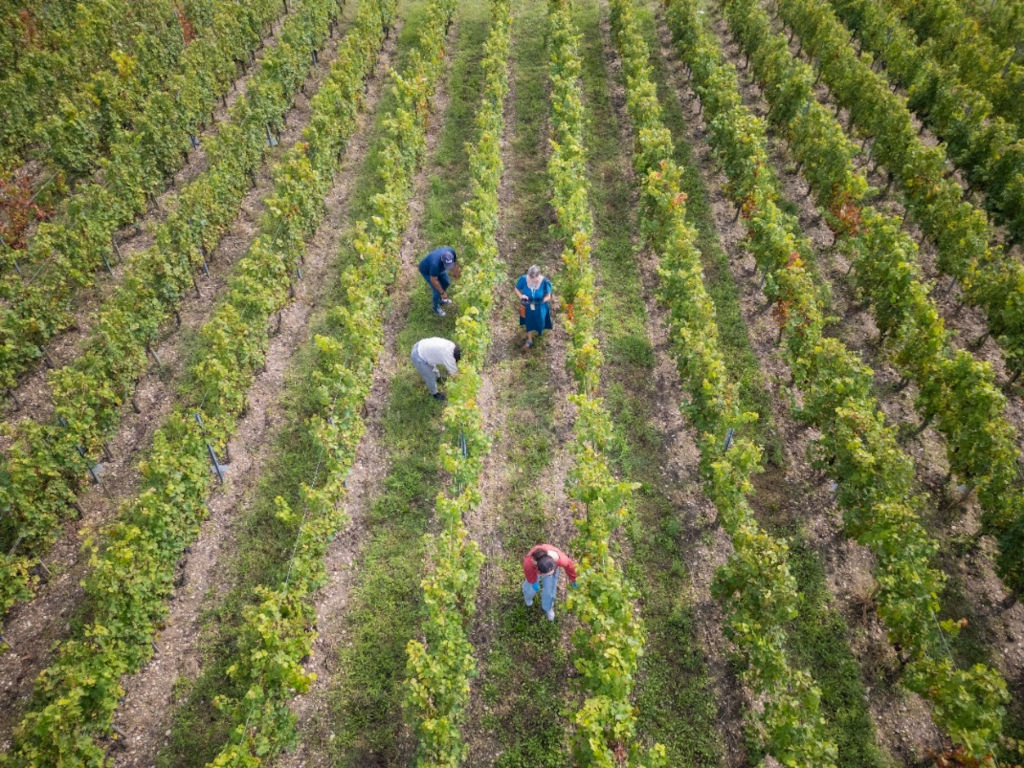
OSCAR observation carried out at Bordeaux INRAE center (the French National Research Institute for Agriculture, Food and Environment) within the joint research unit 1065 SAVE (Vineyard health and Agroecology)
Photo credits: A.Marquot/J.Ducourneau
The French OSCAR DRVs Observatory: https://observatoire-cepages-resistants.fr/observatoire/