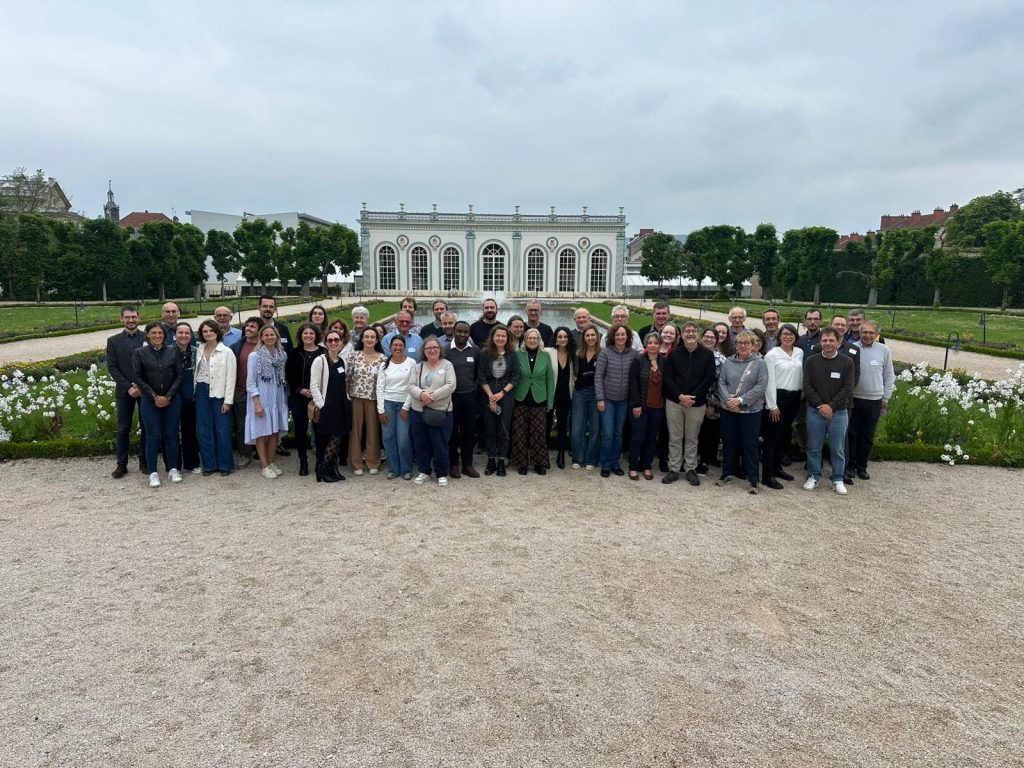
On 6 and 7 May, the second annual meeting of the project “Development of sustainable solutions for viticulture through multi-stakeholder innovation aimed at genetic improvement for integrated pest management (GrapeBreed4IPM)” took place at the Moët & Chandon Champagne premises in the iconic town of Épernay (France). The meeting brought together more than 50 people from the project’s 19 partner organisations, along with the two collaborating organisations, representing seven European countries.
The event was opened by Marc Brevot, director of the Robert-Jean de Vogüé Research Centre, who welcomed all attendees, followed by remarks from Komlan Avia (researcher at INRAE), the project coordinator. Over the course of these two days, the progress of the various work packages carried out during the project’s second year was presented by the work package leaders; the initial scientific and technical results were presented; and several workshops and parallel meetings took place, enabling the partners to address key issues and thus make decisions to facilitate the implementation of the work plan.
Some of these workshops and parallel sessions focused on the results obtained during the Co-Design and Design Thinking Workshops organised across Europe under WP1, the Decision Support System (DSS), the Practical Guide for winegrowers, producers, nurseries and the project’s target audience, the dissemination of the Serious Game “Resist me if you can”, the training activities planned for the years 2026–2028 in the various countries, as well as the Project Results Exploitation Plan, amongst others.
In this way, the focus was placed on the actions to be carried out over the next 12 months, emphasising the importance of disseminating and communicating the results obtained, as well as the disease-resistant varieties themselves and the resulting wines, thereby seeking to maximise their market penetration, both in terms of consumer awareness and within the regulatory framework.
Finally, on 7 May, the Annual General Assembly was held, attended by one representative per partner organisation, providing an overview of the project’s administrative progress.
The GrapeBreed4IPM project is funded by the European Union (GrapeBreed4IPM, grant number 101.132.223). The views and opinions expressed are, however, solely those of the author(s) and do not necessarily reflect those of the European Union or the European Research Executive Agency (REA). Neither the European Union nor the granting authority can be held liable. This project has received funding from the Swiss State Secretariat for Education, Research and Innovation (SERI) No. 24.00152.
The National Institute for Agricultural, Food and Environmental Research (INRAE) leads the project in collaboration with 19 international partners and 2 associated partners: Julius Kühn-Institut – German Federal Research Centre for Cultivated Plants; Istituto di Genomica Applicata; Edmund Mach Foundation; French Institute of Vine and Wine; State Institute of Viticulture in Freiburg; INRAE Transfert; Ludwigshafen University of Business and Society; Rauscedo Cooperative Nurseries; Horta; Ministry of Economy, Transport, Agriculture and Viticulture; Wine Technology Platform; National Interprofessional Committee for Wines with Designation of Origin and Geographical Indication; NEIKER; Mercier, vine nursery; Association of German Vine Plant Producers e.V.; Working Group for the Promotion of Fungus-Resistant Grape Varieties; Moët Hennessy; Polopriverdi Institute of Primeneutics; the Foncalieu Research Institute for Organic Agriculture and Vineyards.
Komlan Avia, a researcher at INRAE center of Colmar, France, is the coordinator of GrapeBreed4IPM. The project began in April 2024 and will run for four years, ending in March 2028.