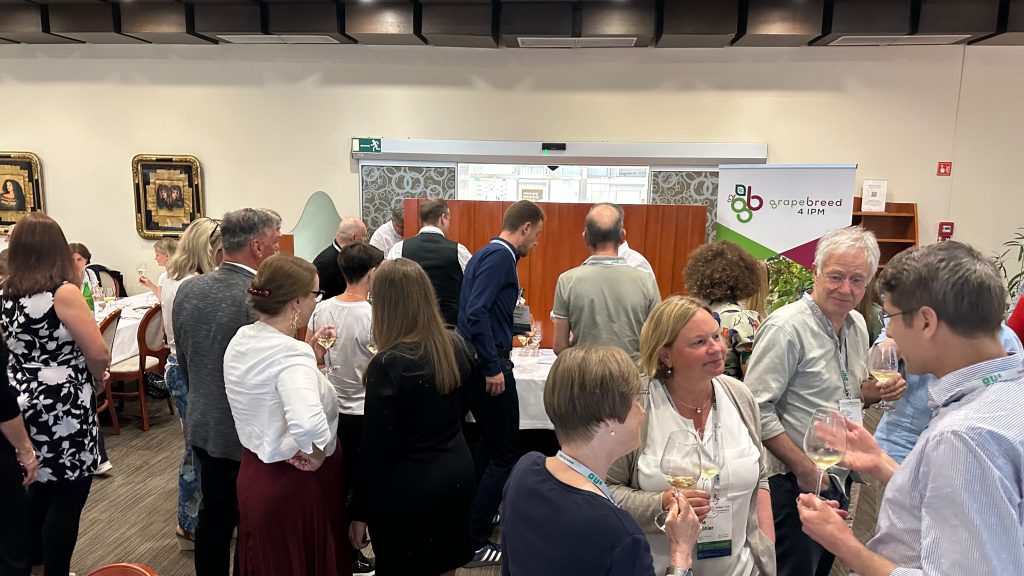
As part of the GrapeBreed4IPM project, the Institute for the Application of Science in Agriculture (IPN/ISAA) organised a Master Class entitled “PIWI Varieties and IPM in Practice” from 15 to 18 June 2026, held during the IALB–EUFRAS–SEASN Conference in Radenci, Slovenia. The session, primarily aimed at agricultural advisors and other rural innovation actors, brought together 78 in-person participants from various European countries and organisations.
The activity combined a technical introduction to disease-resistant grapevine varieties, the principles of Integrated Pest Management (IPM) and low-input production, with a guided educational wine tasting as a learning and communication tool. Through the tasting of samples — including the PIWI variety Solaris alongside regional reference wines such as Tamjanika and Vranac — participants were able to connect technical concepts of disease resistance with product quality, market differentiation, and the communication challenges that advisors face in their daily work.
Evaluation results, collected digitally from 35 participants, reflected a high level of satisfaction and perceived usefulness, with an average score of 8.48 out of 10 across five learning indicators. The highest-rated element was the guided educational wine tasting, scoring 8.8, demonstrating that sensory and experiential learning is effective for translating complex technical concepts into concrete, accessible messages. Professional advisory activities also stood out, generating transferable ideas for participants to use in their training events and demonstration and dissemination activities.
Qualitative feedback highlighted the practical, innovative and accessible nature of the session. Several comments underlined that the main challenge for PIWI variety adoption lies not so much in their agronomic characteristics as in consumer communication and market acceptance.
This Master Class proved to be a replicable and highly relevant training activity for agricultural advisory work, generating messages and tools directly applicable in training, demonstration and dissemination activities, and reinforcing the role of advisors. The results contribute to advancing GrapeBreed4IPM’s objectives in training and communication, and point to the need to strengthen market- and consumer-oriented content in future project training activities.
The project is led by the National Research Institute for Agriculture, Food and the Environment (INRAE), in collaboration with 18 international partners and 2
associated partners: Julius Kühn-Institut – German Federal Research Centre for Cultivated Plants; Istituto di Genomica Applicata; Edmund Mach Foundation; French Institute of Vine and Wine; Freiburg State Viticultural Institute; INRAE Transfert; Ludwigshafen University of Business and Society; Rauscedo Cooperative Nurseries; Horta; Ministry of Economy, Transport, Agriculture and Viticulture; Wine Technology Platform; National Interprofessional Committee for Wines with Designation of Origin and Geographical Indication; NEIKER; Mercier, vine nursery; Association of German Vine Plant Producers e. V.; Working Group for the Promotion of Fungus-Resistant Vine Varieties; Moët Hennessy; Primeneutica Institute of Polopriverdi; Foncalieu Institute for Research in Organic Agriculture and Wines.
GrapeBreed4IPM has a budget of €5,000,000 for its implementation, funded by the European Union under the Horizon Europe programme (grant number 101132223), plus €600,000 from an associated partner and funded by the Swiss Government.